


How much force feedback do you actually need for sim racing? Is an 8Nm direct drive wheelbase enough? Is 12Nm the sweet spot? Does a 25–27Nm motor make you faster—or is it simply more power than you can realistically use?
At UPSHIFT, our view is simple: you do not need 27Nm of torque to have a fantastic time sim racing. The trick is choosing a wheelbase with enough strength for convincing steering feel, sufficient reserve to reproduce sharper effects without clipping, and a cockpit rigid enough to handle it. It's not just how much peak torque you've got; it's how you use it.
Force feedback: the more the merrier? Yes, to an extent! Imagine the drivers at the 24 Hours of Le Mans having to wrestle a constant 27Nm of resistance at the steering wheel in every corner, every hour. They'd all need arms like Arnold Schwarzenegger! Real race-car steering effort changes from corner to corner, and modern GT cars use power steering. Endurance racers need precision and consistency, not an arm-wrestling contest.
Of course, that's a deliberately exaggerated example. A strong momentary peak is different from 27Nm all the time—and just because a wheelbase can deliver 27Nm doesn't mean it should spend the entire race doing so.
First, what does Nm actually measure?
A direct drive wheelbase applies turning force—or torque—directly to your steering wheel. Manufacturers rate that torque in newton-metres (Nm). Higher Nm means the motor can resist or rotate the steering wheel more strongly, but it does not automatically mean better lap times, more realistic steering, or higher-quality force feedback.
Torque also needs context. A 300mm steering wheel has a radius of 0.15m: at 10Nm, the force required at the rim to resist that torque with one hand is roughly 67 newtons, or 6.8kg-force at the rim. That is a meaningful load, particularly during a long race. The actual forces your arms experience depend on where and how you grip the wheel.
There is also an important difference between peak torque (brief maximum output) and sustained or holding torque (what the motor can maintain). Manufacturers do not always quote these figures on the same basis, so comparing a single Nm number between brands is not the entire story.

How much steering torque does a real car produce?
One of the most useful ways to put direct drive wheelbases into perspective is to look at the real cars we're trying to simulate. Real steering effort varies substantially with speed, tyres, suspension geometry, power steering, track surface and even the individual car setup. The figures below are helpful reference points—not fixed limits that apply to every car and corner.
| Vehicle | Steering torque reference | What it tells us |
|---|---|---|
| Modern everyday road car | Approximately 2–3Nm in typical assisted driving; studies report broader ranges | Road cars are designed to be easy and comfortable to steer. |
| Performance-oriented road car | Often around 4–6Nm under more demanding cornering conditions | Sportier steering can be notably heavier without reaching extreme torque. |
| Modern GT3 race car | Roughly 6–8Nm is a useful, commonly quoted power-assisted reference, sometimes higher | Even serious racing machinery does not mean permanently fighting 20Nm through the wheel. |
| Modern Formula 1 car | Approximately 10–15Nm is sometimes quoted as an illustrative range, not a verified universal measurement | Steering effort varies with hydraulic assistance, speed and setup; there is no single published F1-wide value. |
For road cars, published engineering research has reported steering efforts around 2.5–6Nm in ordinary driving, while another manufacturer reference places a typical assisted car around 2–3Nm. GT3 figures are indicative manufacturer guidance rather than a standardised test of every GT3 model. Formula 1 cars use permitted power-assisted steering; the F1 estimate above should be treated cautiously because consistent, publicly available steering-column measurements are scarce.
The takeaway: recreating convincing real-car steering does not require you to run a 25Nm wheelbase at 25Nm. Realistic feedback is about the shape and accuracy of the forces as much as their absolute size.
Why a more powerful wheelbase can still be worth buying: headroom
Imagine you enjoy racing with roughly 9Nm of steering resistance through a fast corner. On a 9Nm wheelbase, that demand is already at the motor's rated ceiling. If the sim now asks for an additional force—a kerb strike, a sudden change in tyre load or a sharp correction—the wheelbase cannot reproduce unlimited extra torque.
On an 18Nm wheelbase producing the same 9Nm at that instant, the motor is operating at roughly 50% of its rated output. There is much more room for the signal to rise before the hardware reaches its ceiling.
That is what we mean by force-feedback headroom: the ability to reproduce the peaks and changes around your normal steering effort, rather than making everything feel equally heavy.
It also explains why buying a stronger wheelbase doesn't mean setting it to maximum strength. You can enjoy a relatively modest steering weight while retaining plenty of reserve for transient effects. Correct tuning is essential, though: even a 25Nm motor can produce clipped feedback if the game signal or gain settings saturate before the signal reaches the hardware.

What is force-feedback clipping?
Clipping happens when the simulation or wheelbase hits its configured force ceiling and cannot express further increases in the requested force. Instead of distinguishing a moderately heavy corner from an even heavier load, the wheel may simply stay at the same maximum output. The subtlety of changes in grip and steering load can be lost.
For example, if your game asks for a stronger force than your chosen maximum allows, it may flatten the top of the signal. Increasing the game's gain to make a weak wheel feel heavier can actually make clipping worse. In iRacing, the on-screen force meter can help identify when the signal is saturating; the developer recommends tuning strength to avoid sustained clipping in normal driving.
More torque provides the potential for more unclipped dynamic range; it does not automatically generate more detail. Game physics, firmware, motor response, control algorithms, encoder quality and your settings all contribute to how good a wheelbase actually feels.
The 1-litre three-cylinder versus 5-litre V8 comparison
Think of two cars: a small 1.0-litre three-cylinder engine and a powerful 5.0-litre V8. Both can cruise at the same speed, but the larger engine usually has considerably more performance in reserve. When you ask for a burst of acceleration, it doesn't have to be operating at the top of its capabilities to deliver it.
Direct drive wheelbases are similar. A smaller motor being asked to deliver close to its maximum torque has less output left in reserve; a larger, higher-rated motor delivering the same torque is operating farther below its own ceiling. That's why a bigger motor can feel effortless and composed even when you aren't using its full strength.
There's a second benefit in some designs: operating farther from a motor's limits can provide more thermal margin during demanding sessions. But this is an analogy, not a mechanical law. Actual motor temperature, longevity and efficiency depend on the specific motor, electronics, cooling and control software. An 18Nm wheelbase at 9Nm is not automatically guaranteed to last longer than a well-designed 9Nm wheelbase at 9Nm.
What you can say is that the stronger unit has more rated torque in reserve—and, with the right settings, that reserve is genuinely useful.
How many Nm should you buy? Our recommendations
- 5–8Nm: an excellent starting point. A properly configured entry-level direct drive wheelbase is already a substantial upgrade from most gear- and belt-driven systems. For road cars, casual racing and many GT experiences, it can be more than enough.
- 9–12Nm: the practical sweet spot for many drivers. Convincing steering weight, useful headroom, and flexibility for GT, formula and endurance racing without needing extremely heavy steering. Our MOZA R12 V2 12Nm wheelbase sits right here.
- 15–18Nm: strong high-end performance without unnecessary excess. More space for force-feedback peaks, particularly if you use heavier steering settings or larger steering wheel rims. The MOZA R16 Ultra is a compelling choice: rated for 16Nm sustained output, with an optional supported firmware/software unlock that can raise maximum output to 18Nm.
- 20–27Nm: serious performance and abundant reserve. This range is primarily for enthusiasts who value a powerful motor operating with considerable headroom, demanding simulation use and extensive adjustability. Examples include the Simucube 3 Pro 25Nm and the Asetek Invicta 27Nm. You do not need to run them at their maximum settings.
- Above 30Nm: diminishing returns become hard to ignore. For a typical home sim racing setup, our view is that this is excessive, unnecessary overkill. If your existing 20–27Nm wheelbase already has all the headroom you can use, paying considerably more for 30Nm+ is likely wasting your money rather than meaningfully improving your racing. Specialist development and professional training are different use cases—but they're exceptions, not the normal buying recommendation.
There is no trophy for being able to wrestle your steering wheel the hardest. A correctly tuned 12Nm setup can be more informative, comfortable and enjoyable than a badly tuned 27Nm one.

Why buy a 27Nm wheelbase if you don't need 27Nm?
Because having the power available is different from using all of it. A premium 27Nm wheelbase can be magnificent at 8–12Nm of everyday steering effort. And yes, there's a novelty in occasionally turning it right up for a laugh, although extremely high forces demand caution and are not something to use casually around your hands and wrists.
- Headroom and dynamic range. A larger motor can reproduce changes in steering load on top of your normal resistance without immediately hitting its physical torque ceiling. This helps avoid hardware clipping. It won't cure game-signal clipping if the simulator's gain is too high. iRacing's official force-feedback guide explains how to check and adjust clipping.
- Rapid changes in force. Premium bases can be engineered for very responsive torque transitions. For instance, Asetek specifies a 9.4Nm/ms peak slew rate for its Invicta 27Nm. Slew rate measures how quickly torque can change; it is not the same as peak torque, and a bigger headline Nm rating alone doesn't guarantee a faster response.
- Sustained performance and potential thermal reserve. A 27Nm motor delivering 9Nm is operating further below its output rating than a 9Nm motor producing its maximum 9Nm. In a properly engineered design, that can mean useful reserve during long sessions. Asetek markets the Invicta for stable endurance performance. Less thermal stress and greater longevity are plausible advantages of some larger systems, not promises: they depend on the actual cooling, motor windings, electronics and operating conditions.
- Better engineering beyond raw strength. High-end units can combine motors with advanced controls, encoders and customisation. The Invicta, for example, features a 22-bit absolute encoder and RaceHub tuning software. Force-feedback detail depends on the entire control system, not just motor torque.
- More options for different cars and rims. A large round wheel and a compact Formula rim can feel quite different at the same motor torque. Extra reserve gives you flexibility across titles, cars and driving preferences.
It's exactly like the V8 engine analogy: a 5-litre V8 is nice partly because it doesn't have to work at maximum capacity to do an ordinary job. With a powerful direct drive wheelbase, you can enjoy the sense of effortless reserve while keeping the actual steering force somewhere sensible. 27Nm is nice to have; it isn't 27Nm you must use.

Why torque has diminishing returns
The biggest change for many sim racers is moving from a lower-powered or non-direct-drive system to their first competent direct drive wheelbase. After that, the gains become increasingly situational.
Moving from 5Nm to 12Nm can transform how much steering weight and force variation you can reproduce. Moving from 12Nm to 16–18Nm adds welcome reserve for enthusiasts who demand it. Moving to 25–27Nm adds still more potential headroom, but the number of drivers who will genuinely use that additional capacity becomes smaller.
Beyond roughly 25Nm, turning the wheelbase up simply because you can may start to work against you. The steering can become so physically demanding that you are spending more effort fighting the wheel than making precise inputs. Fatigue, excessive steering resistance and sudden violent forces are not signs of greater realism. Sometimes it starts to feel like the wheel is driving you rather than you driving the car.
The aim is to communicate the tyres' behaviour and the car's balance—not to win an arm-wrestling contest.
Don't overlook the cockpit: rigidity matters as much as torque
A high-quality direct drive motor is only half of the equation. Every force produced by the wheelbase must pass through its mounting plate, uprights and chassis. If the cockpit flexes or oscillates, some of that sensation is lost in movement rather than reaching your hands cleanly.
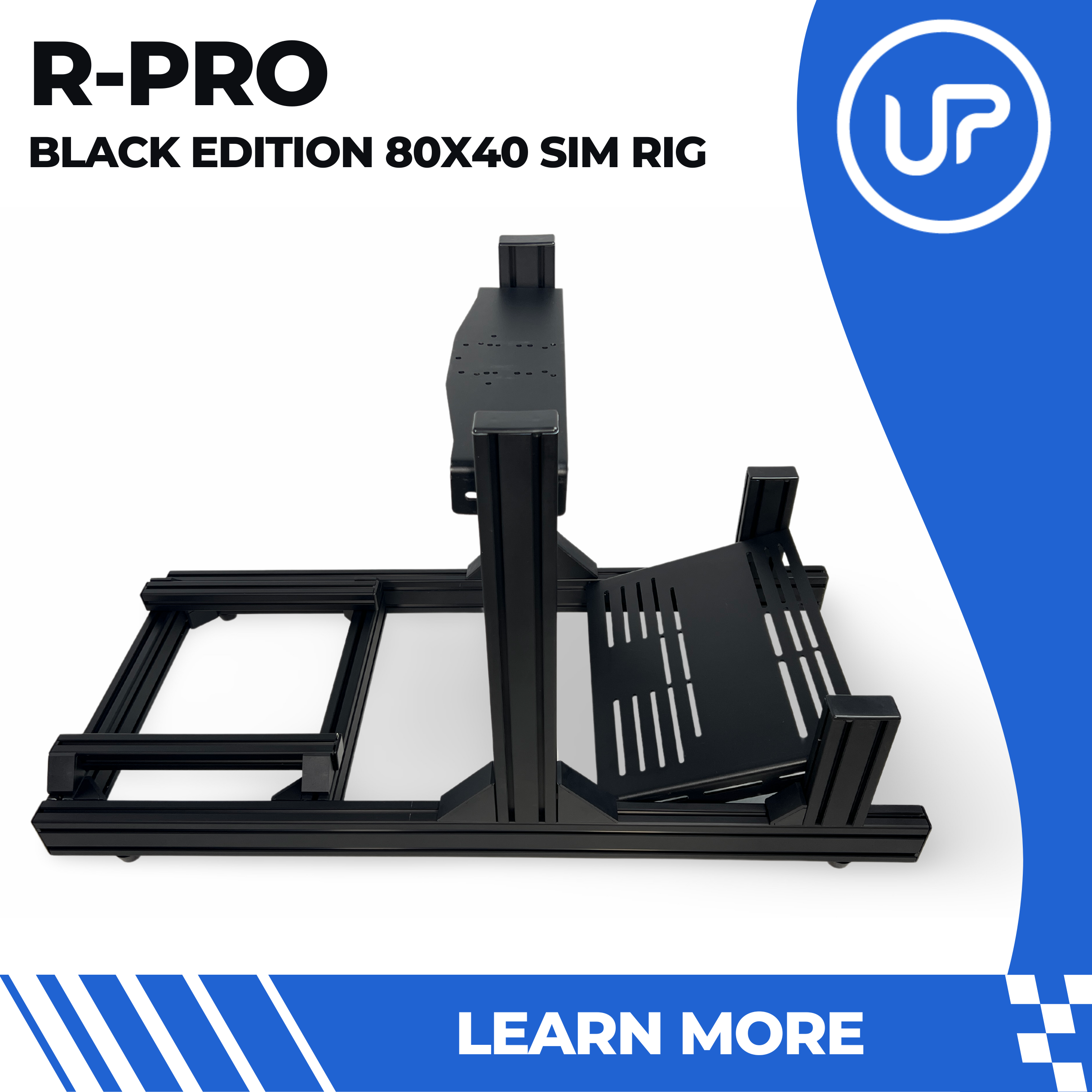
For most drivers using wheelbases up to approximately 15Nm, our UPSHIFT R-PRO Black Edition is an excellent fit. Its aluminium-profile construction is highly adjustable and comfortably supports the demands of the typical mid-range direct drive setup. At the upper end of its working range, or for a particularly strong 16–18Nm wheelbase, we recommend the optional R-PRO Brace Kit and an appropriate secure wheelbase mounting arrangement.
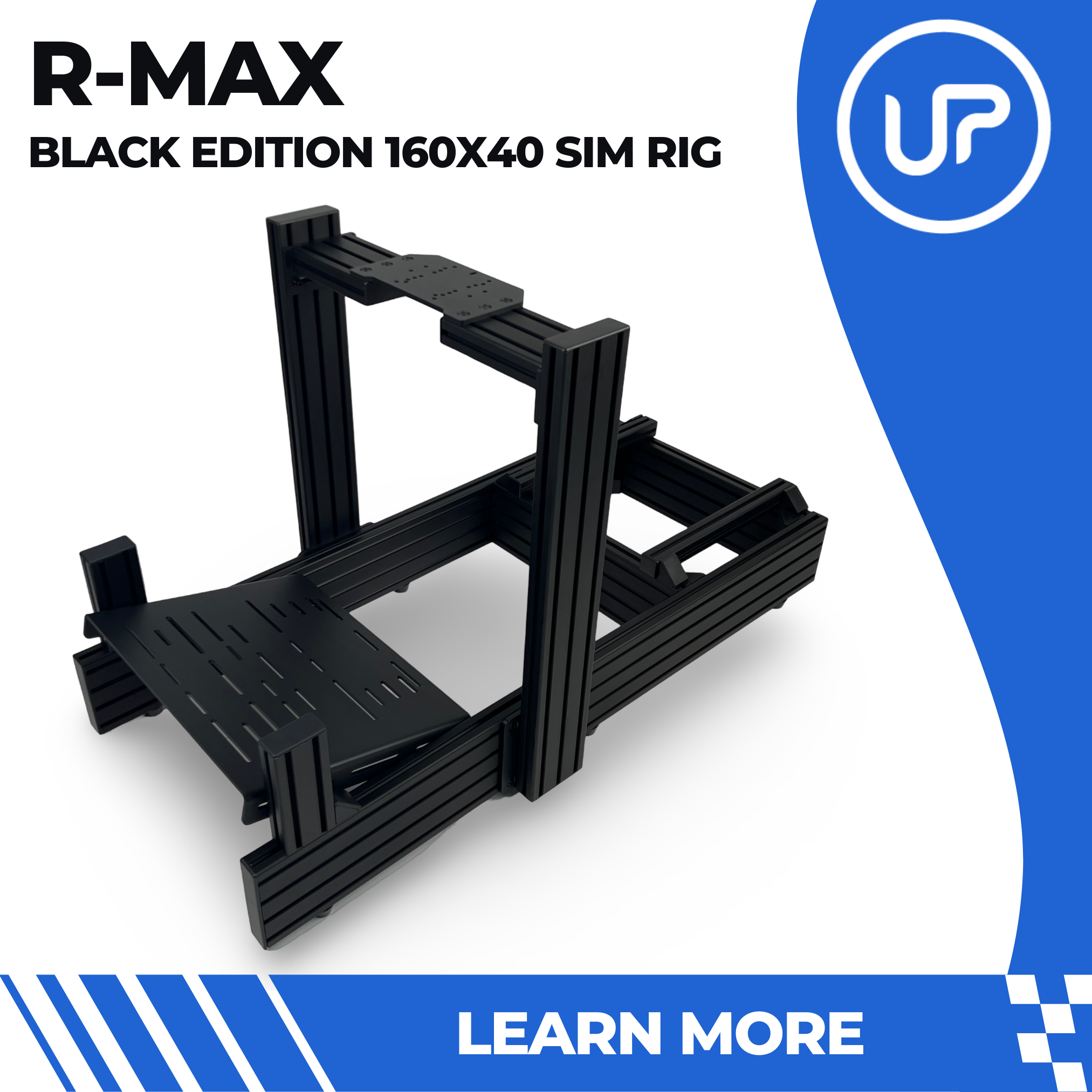
Once you move beyond that level—especially towards 20–27Nm, heavy hydraulic pedals or future motion upgrades—our recommendation shifts to the UPSHIFT R-MAX Black Edition. Its heavier 160×40 base and larger 120×40 uprights are designed for substantially greater rigidity and demanding hardware.
These are our practical cockpit recommendations, not universal laboratory-tested failure thresholds. The exact result depends on wheelbase mounting, configuration, bracing and how aggressively you run the hardware. The strongest wheelbase in the world is wasted if it is attached to a cockpit that flexes every time you turn into a corner.


How to set your force feedback properly
- Start conservatively. Begin a new direct drive wheelbase at a manageable output and increase gradually, rather than immediately selecting maximum torque.
- Set the correct wheelbase rating in your simulator. Where the game asks for your wheelbase's torque capability, enter the manufacturer's correct rating; this is not necessarily the torque you wish to feel all the time.
- Adjust in-game strength for comfortable steering weight. Aim for a believable load you can control precisely throughout a race.
- Check for clipping. Use any in-game force-feedback meter or telemetry indicator, particularly on demanding corners and kerb strikes. Brief isolated peaks are different from constantly saturating the signal.
- Fine-tune the feel. Damping, friction, filtering and response settings vary by wheelbase. Tune gradually so you don't mask useful tyre and road feedback.
- Consider safety. High-torque wheelbases can exert sudden forces during crashes, oscillations and calibration. Keep hands clear during unexpected movements, use an accessible emergency stop where supported, and avoid unnecessarily high strength.
UPSHIFT's verdict: it's not the peak torque size, it's how you use it
You absolutely do not need a 27Nm wheelbase to enjoy great sim racing. For many people, 8–12Nm offers all the realism, immersion and control they need. For committed enthusiasts, 15–18Nm can be an outstanding balance of strength and headroom. A 25–27Nm wheelbase is a luxury worth considering if you specifically want the reserve and the right cockpit to exploit it—but don't mistake the maximum number on the box for the amount of force you should use in every race.
Our advice: choose the wheelbase that can deliver your preferred steering feel without running out of headroom, mount it to a suitably rigid rig, and spend time getting the settings right. More power is useful when it improves the information you feel. Beyond that, it's just a bigger number.
Explore our MOZA Direct Drive Wheelbases, compare the R12 V2 and R16 Ultra, or find the right cockpit in our Sim Racing Cockpits collection.
Research and technical references
- Dols et al., engineering study on real-car steering forces (2021) — road and sports-car references.
- Fanatec: How Realistic Is Wheelbase Torque Compared to a Real Car? — illustrative road-car and GT3 torque ranges.
- iRacing: Controller Setup and Calibration — wheel force and clipping-meter guidance.
- MOZA R16 Ultra specifications and MOZA software torque unlock.
- Asetek Invicta specifications and Simucube 3 Pro specifications.